Three Systems, One Mission
What an American organ recovery practitioner learned inside Poland's national transplant agency and Ukraine's wartime transplant center, and what it suggests about restructuring our own.
About this volume
This is the first volume of a field report. The September draft (v0.4) was written a week after I came home, with a follow-up interview scheduled to close its open questions. That interview, and a parallel follow-up with Poltransplant, have not yet taken place. Rather than hold the report, I have published what can be established now and marked what cannot. Since the draft, several interview figures and secondary sources have been replaced with primary data: Poltransplant's 2025 national report, Ukrainian Ministry of Health statistics, the Ukrainian Institute for Demography's 2026 population estimate, and a February 2026 analysis of U.S. donation-after-circulatory-death data. Where a figure changed, the text says so. Everything still open is listed in the notes at the end and will be addressed in Volume 2.
Abstract
Background. The United States is in the middle of the most significant structural change to its organ procurement architecture in four decades. The Centers for Medicare & Medicaid Services (CMS) Organ Procurement Organization (OPO) Conditions for Coverage Final Rule enters its consequential phase in 2026, with recertification and decertification proceedings scheduled to begin in January 2027. One OPO has already been decertified. Debate over that framework has been almost entirely domestic.
Approach. In September 2026 I traveled to Warsaw and Kyiv to observe two national transplant coordination agencies directly: Poltransplant, which coordinates transplantation for roughly 37 million Poles, and the Ukrainian Transplant Coordination Center (UTCC), which does the same for a country under sustained missile and drone attack. I approached both not as a journalist but as a working American procurement professional with more than 850 recovery procedures and 2,500 organs recovered, and experience across three Florida OPOs that, in the most recent final CMS assessment, sat in three different performance tiers.
Findings. The three systems distribute the same functions across very different institutional architectures and arrive at very different operating points. Poland performs no donation after circulatory death (DCD) and, with Ukraine, recovers about three organs or more per deceased donor. The United States has one of the world's highest deceased-donation rates, second among large systems to Spain, and the lowest organs-transplanted-per-donor ratio of the three, which I hypothesize is largely attributable to a donor pool that is now 49% DCD. Ukraine has roughly doubled transplant volume since 2021 while under invasion, and the constraint that shows most clearly in its published data is donor identification in non-transplant hospitals rather than surgical capacity or organ utilization. Poland's own data point to the same lever: its record growth since 2021 came from more potential donors being identified, not from better conversion.
Interpretation. The comparison does not identify a superior system. It does suggest that the two CMS outcome measures, a donation rate and a transplantation rate, can move in opposite directions under the same policy, and that the United States should understand which of its functions are actually load-bearing before restructuring the organizations that perform them.
About the author
I have worked in organ recovery for more than five years, most recently as a surgical services coordinator for an organ procurement organization in Central Florida. Over that time I have taken part in more than 850 recovery procedures and the recovery of more than 2,500 organs across three Florida organ procurement organizations, in different regions of the state and under different organizational models. As it happens, those three sat in three different CMS performance tiers in the most recent final assessment, which is the vantage point Section 3 draws on.
That background is the reason this report exists and also its principal limitation. I am not a neutral observer of the American system. I am a practitioner inside it. I do research like this because I want to rather than because a job assigns it, and I went abroad partly because I am worried about what is about to happen to the system I work in. Readers should weigh the observations accordingly, and I have labeled every claim so they can.
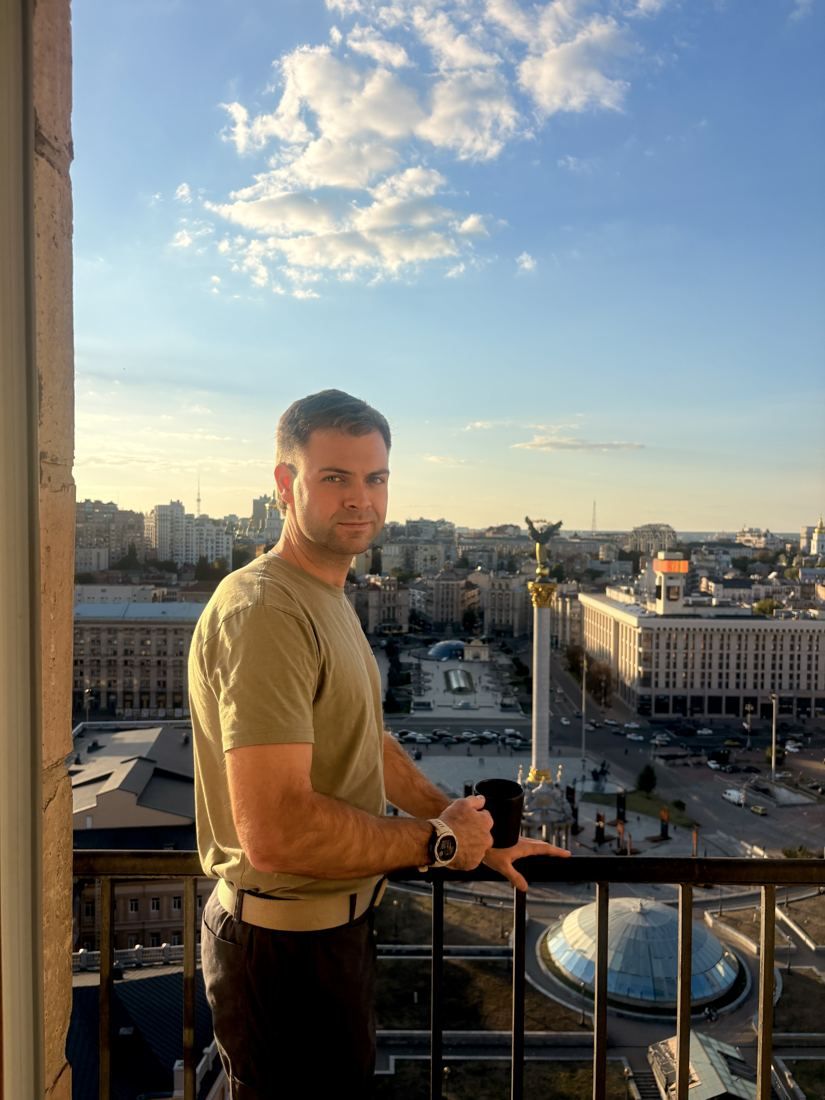
Section 01
Thirty minutes past the border
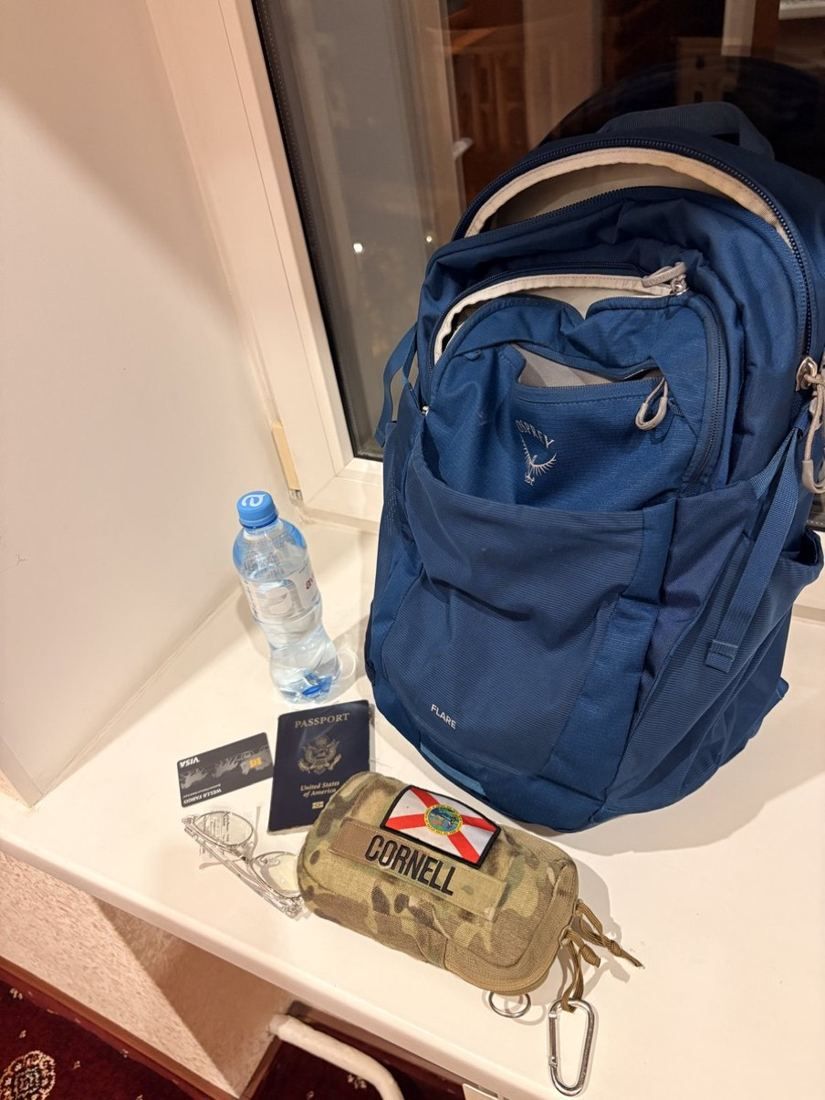
The train stopped about half an hour after we crossed into Ukraine, just after sunrise. The evacuation order came three times in a row. I had scrub pants and boots on, hastily, and I took a passport and a bottle of water and nothing else. Drones were reported in the area. A few hundred of us stood in the cold a couple hundred yards off the tracks, lost, waiting.
I had been in the country for thirty minutes.
I mention this first because everything I subsequently learned about Ukrainian transplantation should be read against it. I did not study a wartime health system from a conference room in Brussels. The logistics I was there to ask about (how do you move a heart when the airspace is closed, when the rails stop, when the roads are unpredictable) were being demonstrated on me before I reached Kyiv.
The day before, I had been in Warsaw, in a Poltransplant office with worn carpet and instant coffee and a phone that would not stop ringing, and the thing that struck me hardest there was not how different it was. It was how completely familiar it sounded.
This report is an attempt to hold those two experiences against the American system I work in, at a moment when that system is being restructured by regulation, and to ask a question that I do not think has been asked carefully enough: before we change the architecture, do we actually understand which parts of it are load-bearing?
Section 02
How to read this report
Field reports blur categories. A thing an official told me over coffee, a number from a government registry, and a conclusion I drew on the flight home are three very different kinds of claim, and collapsing them is how travel writing gets mistaken for evidence. Every substantive statement below carries one of four markers.
| Marker | Meaning |
|---|---|
| A | Firsthand observation. Something I personally saw, heard, or experienced. |
| B | Interview finding. Something a named Polish or Ukrainian professional told me. Not independently verified unless a C follows it. |
| C | External evidence. Confirmed against statute, government data, registry reporting, or peer-reviewed literature. Cited. |
| D | Author interpretation. My conclusion or hypothesis. Argue with these. |
Where the record is still incomplete, a numbered note points to the list of open items at the end. Most will be closed in Volume 2, after the follow-up interviews.
Section 03
The system I came from
An American reader may not need this section. A Polish or Ukrainian one will, and so will a policymaker who has only encountered organ procurement through a hearing transcript.
The United States does not have a national organ procurement agency. It has 55 federally designated, independent organ procurement organizations, each holding an exclusive Donation Service Area, certified by CMS, operating alongside a separate national allocation contractor (the Organ Procurement and Transplantation Network, overseen by HRSA), alongside separately accredited transplant centers, alongside donor hospitals bound by federal referral requirements. Functions that a Polish or Ukrainian reader would expect to find inside one building are distributed across four kinds of institution with different funders, different regulators, and different incentives.
The operational chain an OPO owns runs: referral, evaluation, authorization, donor management, recovery, placement, transport. Three parts of that chain are easy to underestimate from outside. Referral is compulsory: American hospitals must notify their OPO of every death and imminent death, which is the single regulatory mechanism that keeps donor identification from collapsing in hospitals that have no transplant program and no institutional reason to care. Death record review is the retrospective audit of every hospital death to find the donors who were missed. Donor hospital development is a standing staff function whose entire job is the relationship with non-transplant hospitals. None of the three involves an operating room. All three are why the operating rooms have anything to do.
Field note A
In five years I have never once been dispatched because a hospital independently decided a patient might be a donor. I have been dispatched because a referral trigger fired, a coordinator screened it, and somebody who does this full time made a judgment. The surgical recovery is the visible part of the job and the smallest part of the system.
The regulatory moment
C The 2020 CMS OPO Final Rule replaced self-reported performance measures with two registry-derived ones. The donation rate is the number of donors in a DSA as a percentage of inpatient deaths among patients 75 or younger whose primary cause of death is consistent with donation. The transplantation rate uses the same denominator but counts organs transplanted. The pass mark for both is the lowest rate among the top 25% of OPOs in the prior period, a moving benchmark that by construction places roughly a quarter of OPOs at the top and half below the median.1
C Performance sorts OPOs into three tiers. Tier 1 recertifies automatically for four years. Tier 2 keeps its certification but must compete to retain its service area. Tier 3 is decertified and may not compete for anyone else's.1 Under CY2021 performance data, roughly 42% of OPOs were on track for automatic decertification.2n16
C This is no longer hypothetical. On 18 September 2025, HHS decertified a Florida organ procurement organization, citing years of unsafe practice, chronic underperformance, and understaffing.3 In January 2026 that donation service area was awarded to an out-of-state OPO.2 A 2026 proposed rule would move accountability to the DSA level, allow Tier 2 service areas to be opened to competition continuously rather than at fixed cycles, and remove the restriction that limited new OPO certification to organizations recertified between 2002 and 2005, opening the field to new entrants. Recertification and decertification proceedings begin January 2027.2
C Separately, in July 2025 HRSA directed system-wide reforms after finding that donation-after-circulatory-death recovery had in some cases been initiated on patients still showing signs of life and that mandatory waiting periods had sometimes not been observed. All OPOs are now required to designate Patient Safety Officers.4
D I want to be careful here, because my own position is not neutral and I would rather state it plainly than smuggle it in. I believe the current framework is applying structural pressure faster than anyone has measured its operational consequences, and that we are going to dismantle procurement infrastructure before we understand what it was doing. I also believe the HRSA safety findings are real, serious, and not something the profession gets to wave away. Both of those can be true. Section 13 tries to hold them together.
An accident of biography
C D I have worked at three Florida organ procurement organizations. As assessed on CY2021 performance data, one was Tier 1, one was Tier 2, and one was Tier 3.2 A fourth Florida OPO, also Tier 3, has since been decertified.23 I am deliberately not naming any of them; the tier distribution is a matter of public record and the point here does not depend on which organization is which.
I did not plan this. But it means I have worked inside all three CMS performance tiers, in one state, doing recognizably the same job, and I can say from the floor that the differences between those organizations were real but were not differences of commitment. They were differences of hospital mix, donor demographics, staffing depth, and the accumulated quality of relationships with intensive care units that took years to build and can be lost in one reorganization.
Section 04
Warsaw: one agency for thirty-seven million people
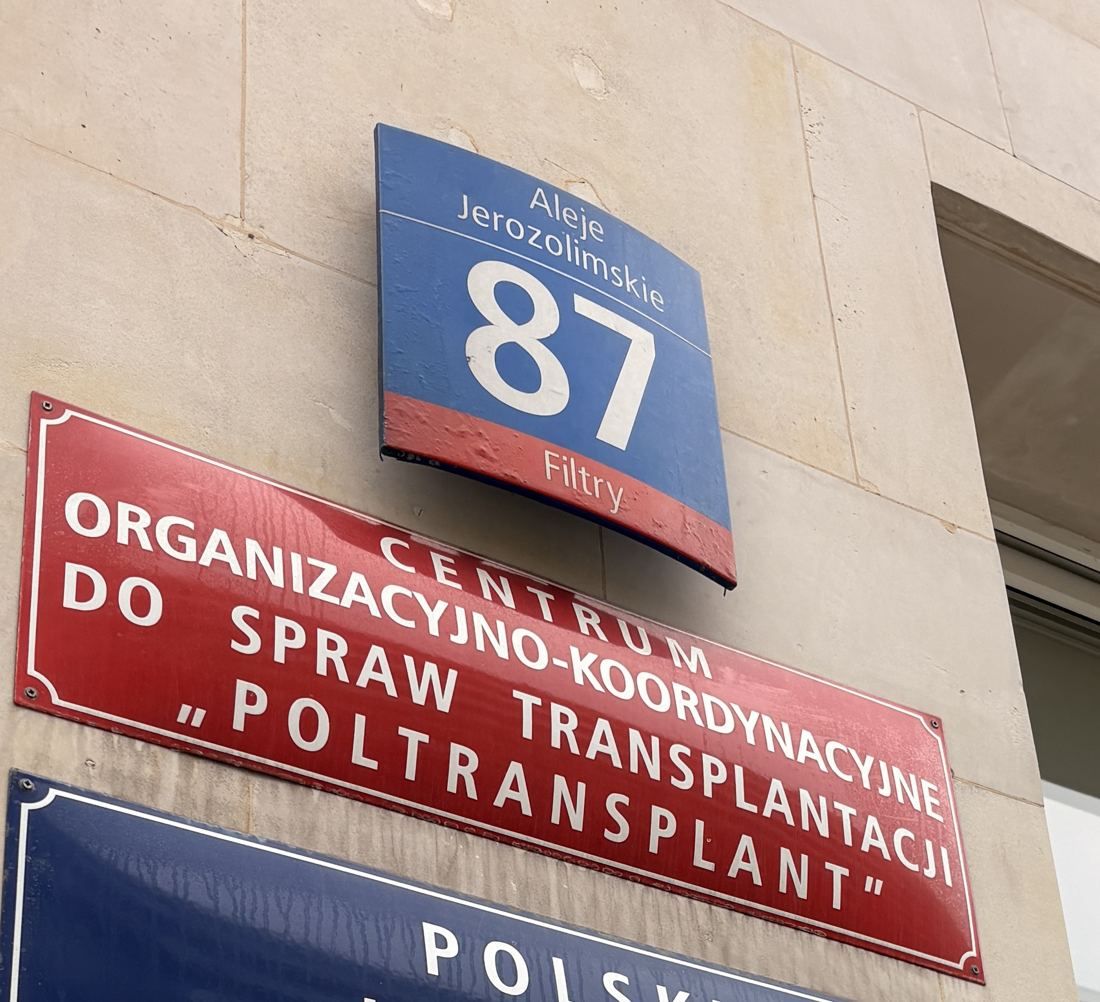
Poltransplant, formally the Organizational and Coordinating Center for Transplantation, sits at Aleje Jerozolimskie 87 in Warsaw, behind a red enamel sign of the kind that Central European institutions have used for a century. It reports to the Ministry of Health. It is, functionally, the entire national procurement and allocation architecture of Poland in one organization: national coordination, the waiting list, the registries, allocation, organ exchange, living-donor coordination, coordinator training, quality systems, and international cooperation.
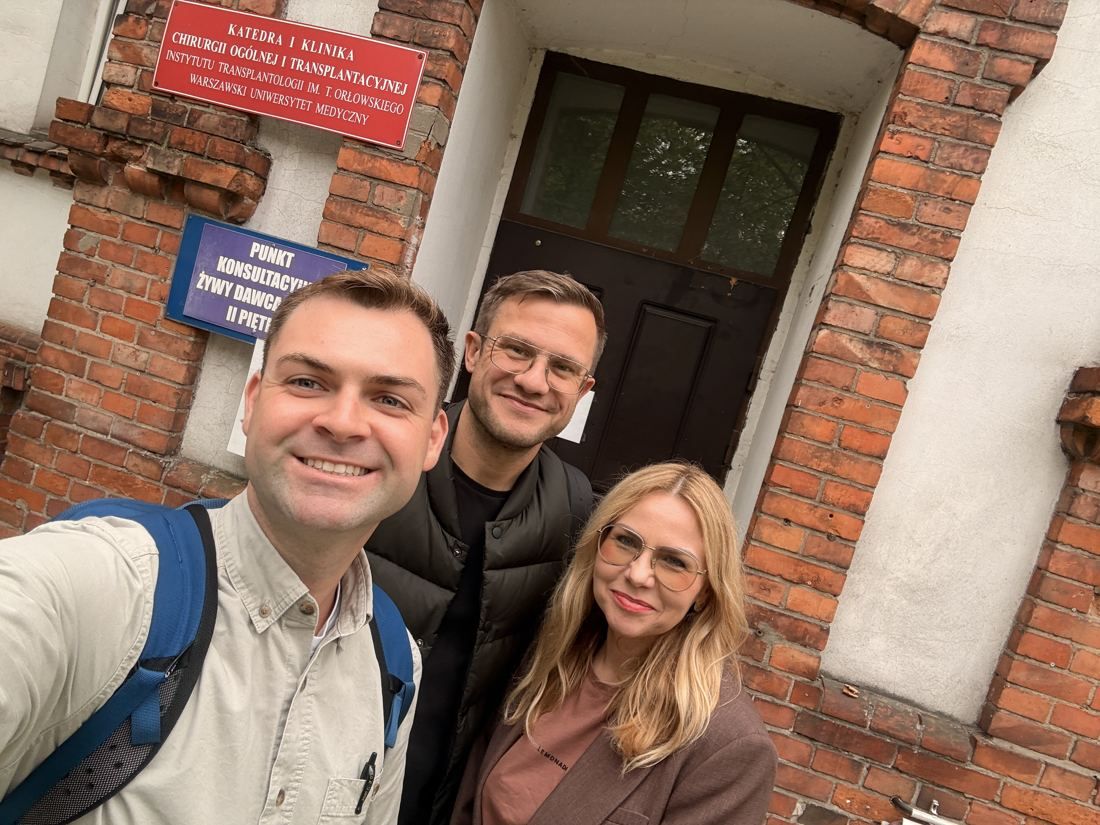
I met Dr. Anna Pszenny, head of the Department for International Cooperation and a transplant coordinator, who also chairs the Council of Europe / EDQM Network of National Focal Points on Travel for Transplantation and sits on the board of the European Donation and Transplant Coordination Organisation; and Dr. Łukasz Górski of the Central Clinical Hospital of the Medical University of Warsaw, who together hosted my visit. The invitation was arranged by Jarosław Czerwiński of Poltransplant; the agency is directed by Prof. Artur Kamiński.5 A planned visit with a senior professor at one of Warsaw's transplant centers was cancelled when I moved my departure for Ukraine forward.n1
What the office sounded like
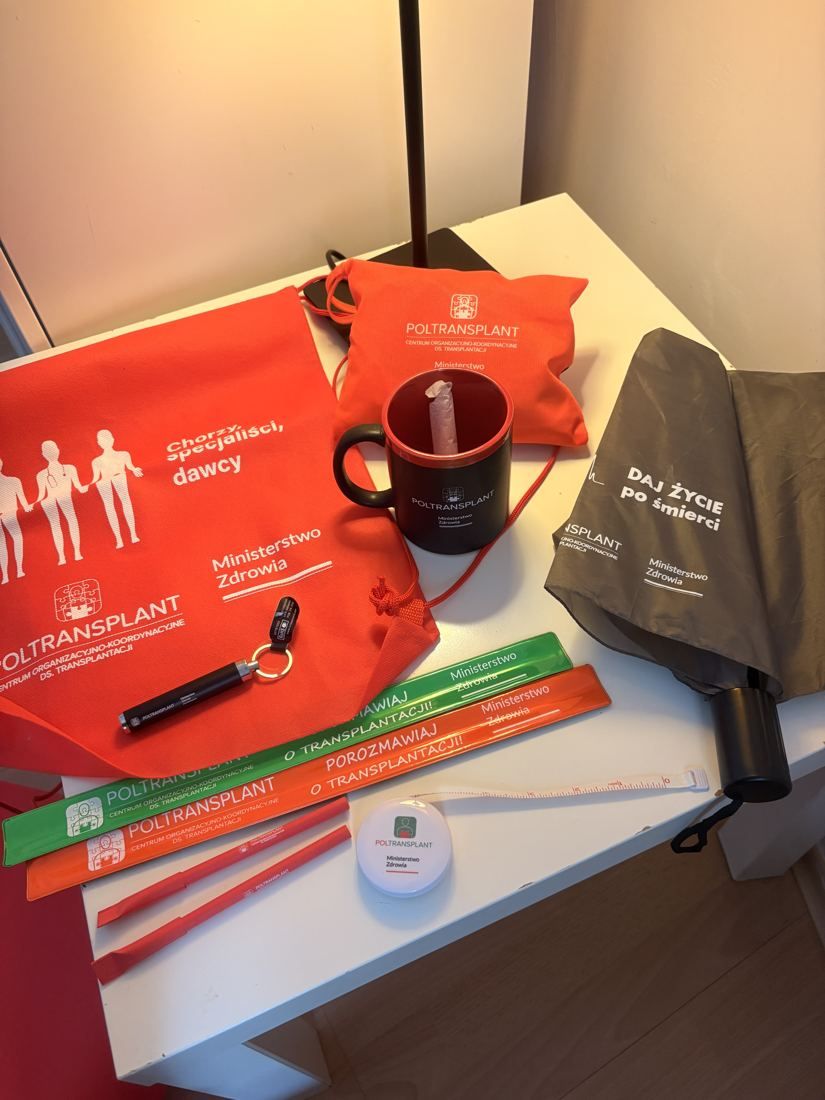
A Phones ringing. Two coordinators consulting each other over a desk. A conversation about a potential donor at a hospital somewhere else in the country. A director walking through with a question. Cramped desks, old carpet, instant coffee, gray Warsaw weather through the window, and nothing whatsoever spent on appearance.
I have stood in that room before. It was in Gainesville.
D I want to be careful not to turn this into a romance about austerity. Worn carpet is not a virtue and instant coffee does not save lives. The observation is narrower and I think more useful: the institutional architecture was completely different and the operational culture was immediately recognizable. The same triage cadence, the same tone on the phone with an ICU, the same particular exhaustion of people doing time-critical work on someone else's schedule. Whatever it is that makes procurement work, it is apparently portable across organizational designs. That is a genuinely interesting finding, because the current American policy debate is almost entirely an argument about organizational design.
The coordinator network
B The Polish team described a hospital-coordinator network of roughly this shape: about 10 coordinators inside Poltransplant itself, about 33 in transplant centers, and roughly 335 in donor hospitals, covering approximately 238 of about 388 hospitals with donation potential.n2
C Poland's Supreme Audit Office found in its review of the national program that coordinators had been appointed in 255 of 388 hospitals with donation potential, and that participating hospitals reported only about 1.5% of deceased patients as meeting donation criteria.6 The order of magnitude in my field notes is consistent with the audit.
B Polish coordinators are physicians or nurses. That differs from my American experience, where the coordinator workforce also includes respiratory therapists, paramedics, and people who entered from non-clinical backgrounds and were trained into the role. Poltransplant runs annual training; I learned of a recent meeting of the Polish Society of Transplant Coordinators that functions much as the Association of Organ Procurement Organizations does professionally in the United States.
B HLA typing runs through regional laboratories, Gdańsk and Kraków among them. The American equivalent in my experience routes specimens to regional labs in Tampa, Miami, or Atlanta. Two very different national systems arrived at the same solution to the same problem, which is worth noticing: not every structural difference is a choice, and some are just physics.
Consent
C Poland operates on presumed consent with a Central Register of Objections. A person who does not wish to donate registers an objection; a written or, in defined circumstances, witnessed oral objection also applies. At the end of 2025 the register held 51,445 statements, 51,053 of them objections.5 A donor card is not the primary legally binding instrument.
D The most common American misreading of presumed consent is that families are bypassed. That is not what I observed or was told. The legal authorization framework and the ethical conversation with a family are separate things, and Polish coordinators still have the conversation. What presumed consent changes is the default position from which that conversation starts, and who bears the burden of having made a decision in advance. Poltransplant's own pathway table makes the point: in 2025, 17% of reported potential donors did not proceed for lack of authorization.5
Poland does not do DCD
B The Polish team told me plainly that there is no routine DCD program. Transplantation in Poland is overwhelmingly brain-death based. Polish ethical culture, as it was described to me, has not embraced DCD; related questions about end-of-life treatment withdrawal remain unsettled.
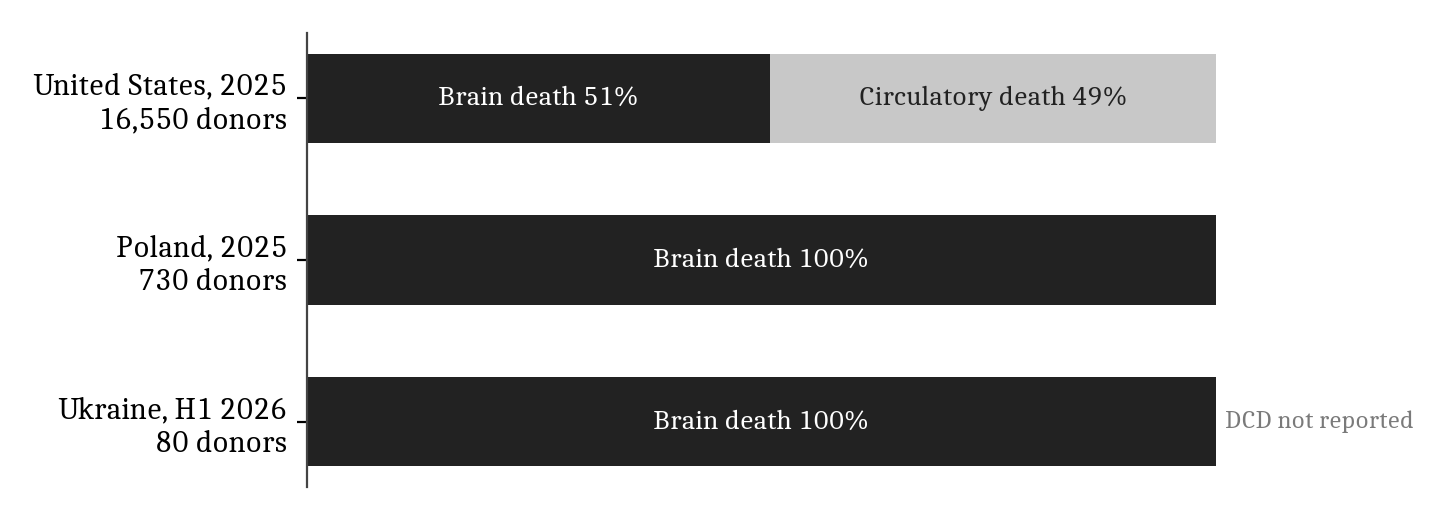
C The national data support this without qualification. In 2025 Poland recorded 730 actual deceased donors, 19.52 per million population and the highest rate in its history, and death was determined by neurological criteria in every case.5 (The September draft used 2022 figures; the 2025 report supersedes them.)
C In the United States in 2025, DCD accounted for 49% of all deceased donors, 8,129 donors, up from 2% and 118 donors in 2000, with substantial variation between OPOs.7
D This is the single largest structural difference between the two systems, and it is not a difference of competence. It is a difference in what the two countries have decided is ethically settled. Everything downstream (donor counts, organ yield per donor, waiting times, the shape of the workforce) follows from it.
Figure 1. The same procedure, three different donor pools
Donor mix, exclusions, living donation
B C Stroke is the dominant donor mechanism in Poland. Poltransplant's 2025 report bears this out: cerebrovascular disease accounted for 57.5% of donor deaths, craniocerebral trauma 17%, and other causes, including poisoning, asphyxia and benign brain tumors, 25.5%.5
D The tempting American gloss here, "Poland has stroke donors, America has overdose donors," is too crude to be useful and I am not going to make it. American donor case mix is genuinely different and genuinely heterogeneous by region, and the more defensible statement is narrower: a donor pool whose center of mass is a stroke patient produces different organ yield, different exclusions, and different recipient outcomes than one that is half DCD.n4
B Absolute exclusions described to me included HIV, malignancy, Creutzfeldt-Jakob disease, uncontrolled sepsis, and certain trauma. Relative considerations included age, sclerosis, controlled sepsis, diabetes, HBV, and HCV. These criteria change over time and by organ.n3
B C Living donation is modest and the Polish team regard it as too low: in 2025 Poland transplanted 69 kidneys and 37 liver fragments from living donors.5 Preemptive kidney transplantation is relatively common, and I was told kidney waiting time runs around one year. The national audit put the average kidney wait at 430 days, with heart at 603 days and lungs at 225 days.6 Those figures are consistent.
D A one-year kidney wait against an American wait commonly measured in years is the number Polish colleagues are proudest of, and it is the number an American reader will find most provocative. It should be handled carefully. Waiting time is a ratio, and its denominator is who gets listed. A shorter queue can reflect a smaller queue as much as a faster one. Waiting time alone proves very little about system performance, and I would resist any American argument that leans on it.n5
Poland outward, and Poland's turnaround
C Poland participates in European cross-border organ exchange through the FOEDUS-EOEO platform, which allocates deceased-donor organs internationally when no suitable recipient exists in the donor country. After Eurotransplant joined in February 2022 the network reached 25 states and more than 500 million people. Between 2015 and 2021 the platform handled 1,483 organ offers, of which 287 were transplanted, a 19.4% utilization rate.10 In 2025 Poltransplant coordinated procurement and transplantation from 55 donors outside Poland.5
C In 2025 Poland transplanted 2,411 organs, 2,304 of them from deceased donors, and retrieved 2,619 organs from deceased donors.5 Set that against the national audit: donation had fallen from roughly 14 per million in 2016 to 10 in 2020, and the auditor called the program a system in crisis.6 Five years later it is at a record 19.5 per million.
C Poltransplant's own pathway table offers the first clue to how. Between 2021 and 2025 the number of potential donors reported by Polish hospitals rose from 546 to 969, an increase of 77%. The share of reported donors who became actual donors stayed in a narrow band, 70% to 76%, every year. Actual donors rose from 396 to 730.5
D In other words, Poland's growth came at the front of the pipeline, from hospitals identifying and reporting more potential donors, not from converting a higher share of them. That is the same narrow point the Ukrainian data show in Section 7, and it is the function American referral rules exist to protect. Why Polish referrals rose (coordinator appointments, financing, hospital incentives, public education) is the most important question for the Poltransplant follow-up.n6
Section 05
Kyiv: the meeting that almost did not happen
The Ukrainian Transplant Coordination Center is a Specialized State Institution under the Ministry of Health. Its remit is wider than Poltransplant's and much wider than any American OPO's: it coordinates organ transplantation, runs the national bone marrow program, and administers the national blood and transfusion system. It operates ЄДІСТ, the Unified State Information System of Transplantation, live since January 2021, which comprises nine registers covering consent declarations, procured anatomical materials, living donors, recipients, accredited facilities, and transplant coordinators. Consent can be filed digitally through Diia, Ukraine's national e-government application.1112
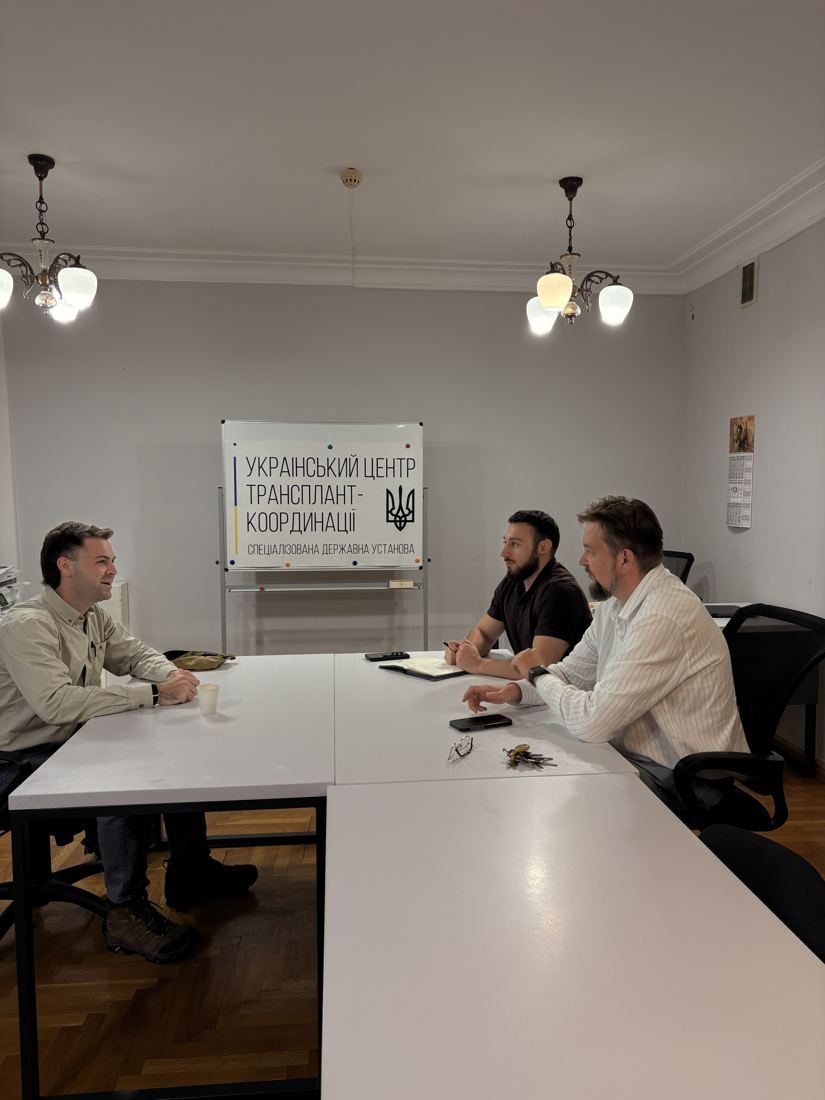
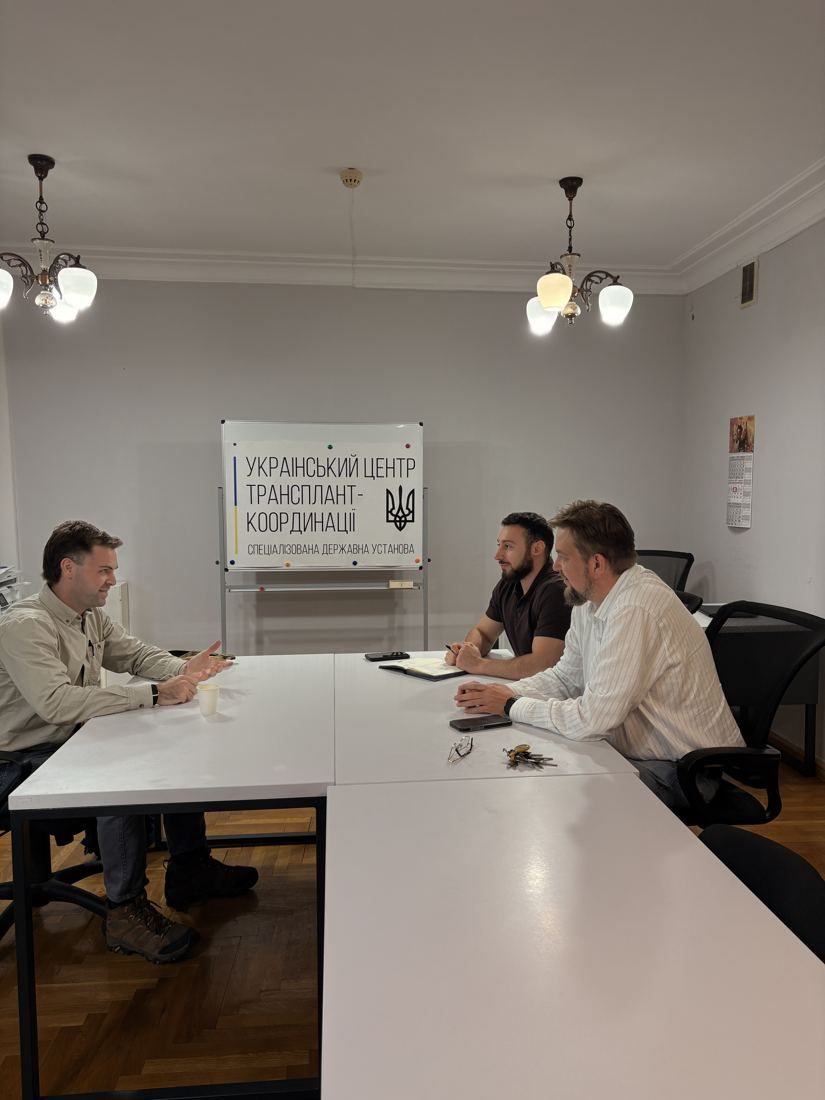
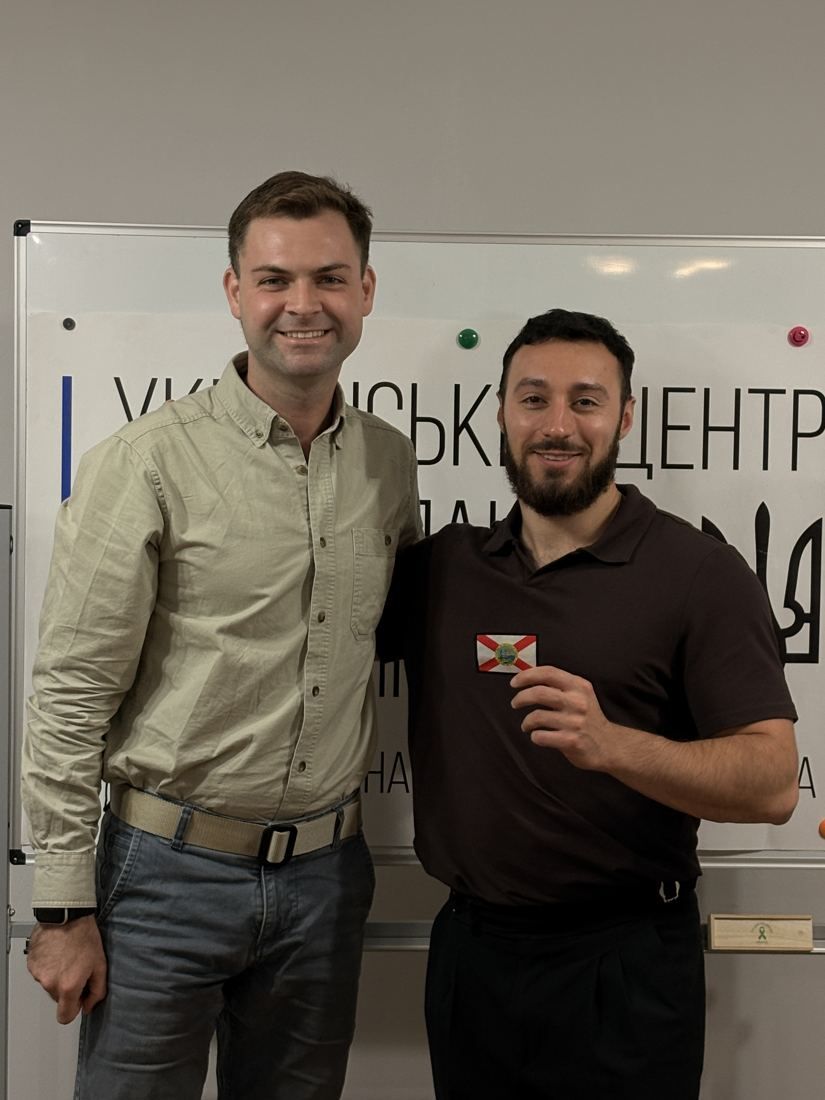
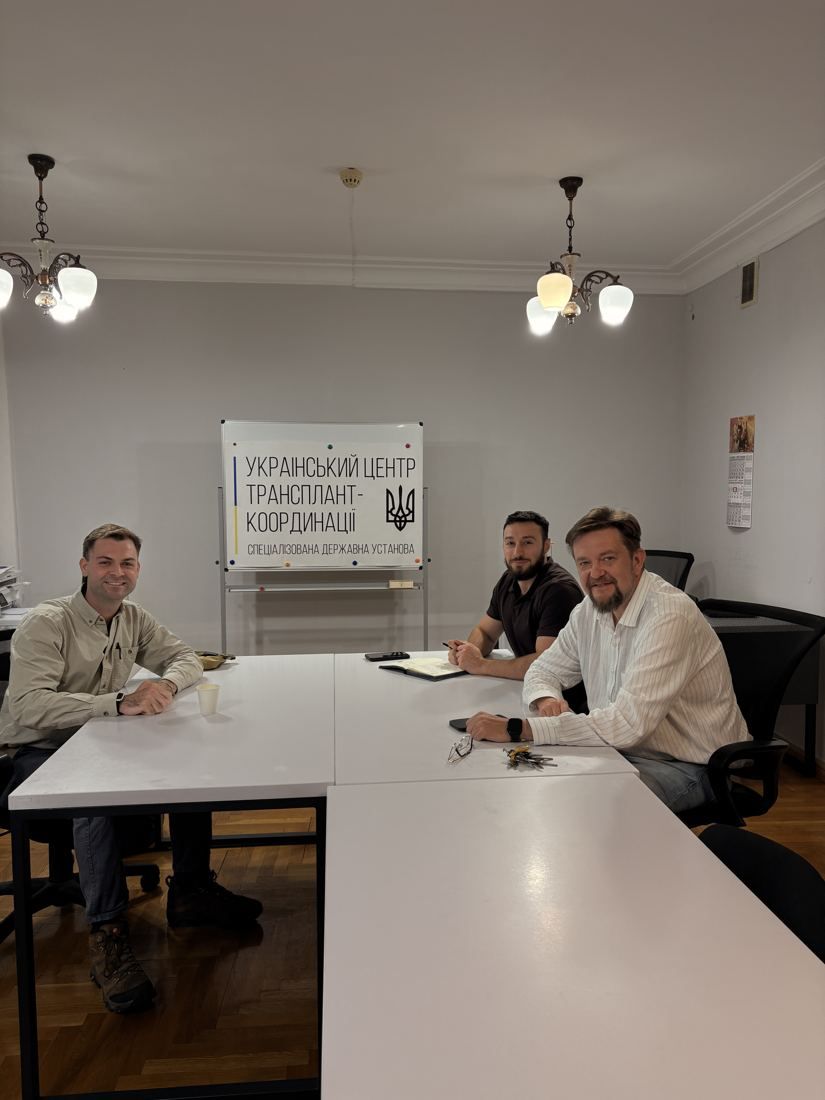
A I met Dmytro Koval, General Director, and Artur Karamian, a cardiothoracic surgeon who heads the Organ Transplantation Division. We sat for roughly two hours.
B They had intended to take me to hospitals. The overnight attack had affected infrastructure that UTCC's information systems depend on, and the servers had to be shut down. Restoration work and contingency planning were underway that morning, which is why the hospital portion of my visit did not happen.n7
D The tour I did not get was itself the most precise data point of the trip. I had come to ask how a transplant system functions under attack, and the answer arrived as a schedule change.
What they wanted to talk about
B The headline finding of the meeting, and the reason it warrants a paper rather than a blog post: Ukraine is actively interested in the American regional procurement model. My contemporaneous note reads, verbatim, "Want OPO system → trying to come to US model."
B This is not abstract. In 2023 Ukrainian transplant leadership traveled to the United States to study transplant center operations, including visits to Mayo Clinic and the University of Florida, where I trained. They knew a cardiothoracic surgeon I have worked alongside in Orlando. The General Director was also, to my surprise, conversant with American problems: low transplant rates in parts of the system, Medicare reimbursement difficulties. He was not asking me what the American model is. He was asking me what is wrong with it.n20
D I want to state the limit of this finding carefully, because it is the claim most likely to be over-read. Ukraine does not have a finalized plan to create American-style OPOs. What I can report is that Ukrainian officials studied the American model deliberately, believe elements of it would be advantageous, and are contrasting it against the Polish national model they know well. Whether that becomes policy is exactly what the follow-up interview is for.
D It is also worth registering the irony, which I felt in the room and have not resolved since. A country at war is looking to import an architecture that its originating country is currently restructuring under a decertification regime.
How Ukrainian transplant centers take patients
B Transplant centers accept all patients regardless of referring physician documentation; payment runs through the National Health Service of Ukraine. Recipient criteria include behavioral factors: alcohol use places a candidate lower on the list, as does smoking.
B The indications they described map recognizably onto Western practice. Hearts: cardiomyopathy. Lungs: congenital heart disease including tetralogy of Fallot. Pediatric kidney: end-stage renal disease on dialysis. Liver: hepatocellular carcinoma and cirrhosis, which they described as a substantial national burden. They were explicit that Ukraine has a relatively healthy population and that wartime trauma does not define the donor pool.
D That last point deserves emphasis because the opposite assumption is the natural one for a Western reader, and it is wrong. Ukrainian deceased donation is driven by the same neurologic and medical deaths that drive it everywhere else.n15
Section 06
The night of 16 September
A Drone alarms become a second reality quickly. Yellow alerts arrive on your phone every few hours. Some people go to shelters, most do not, and the city keeps working. I had expected that and I adapted to it within a day.
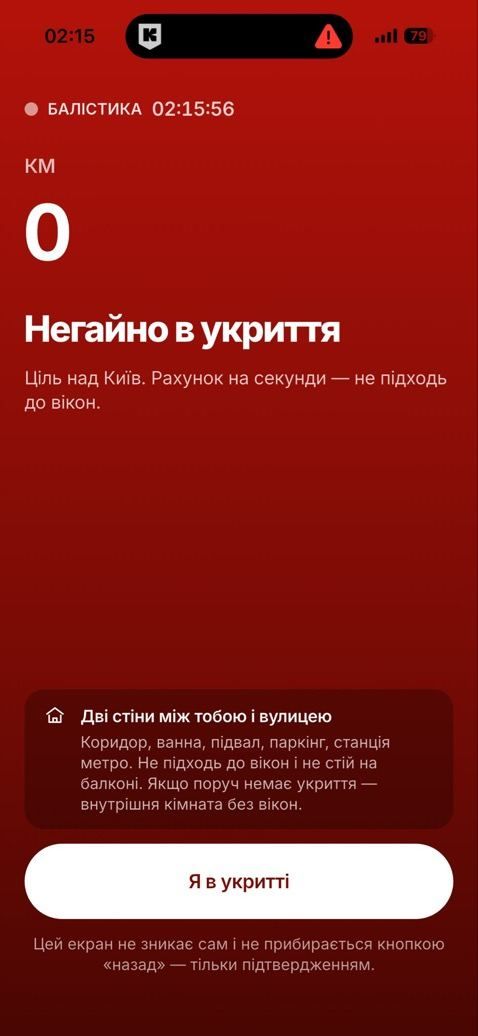
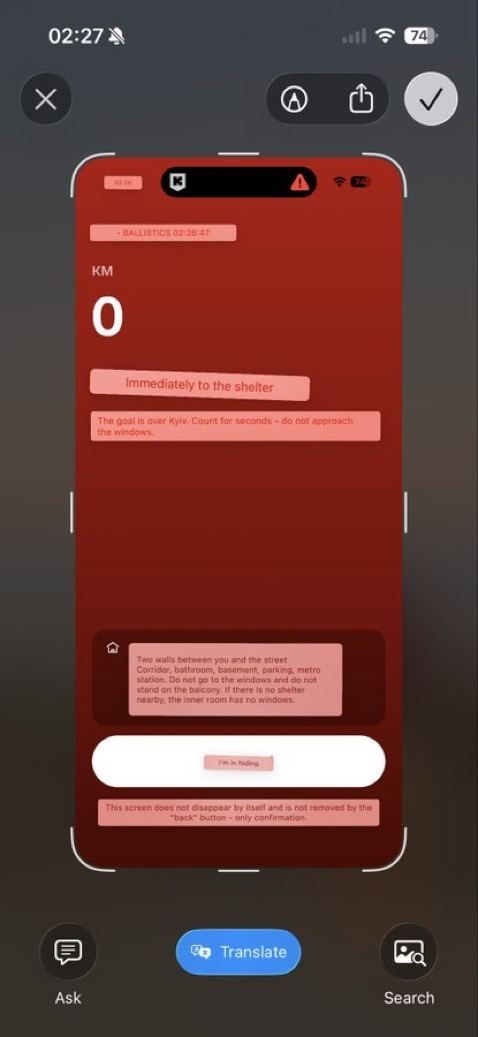
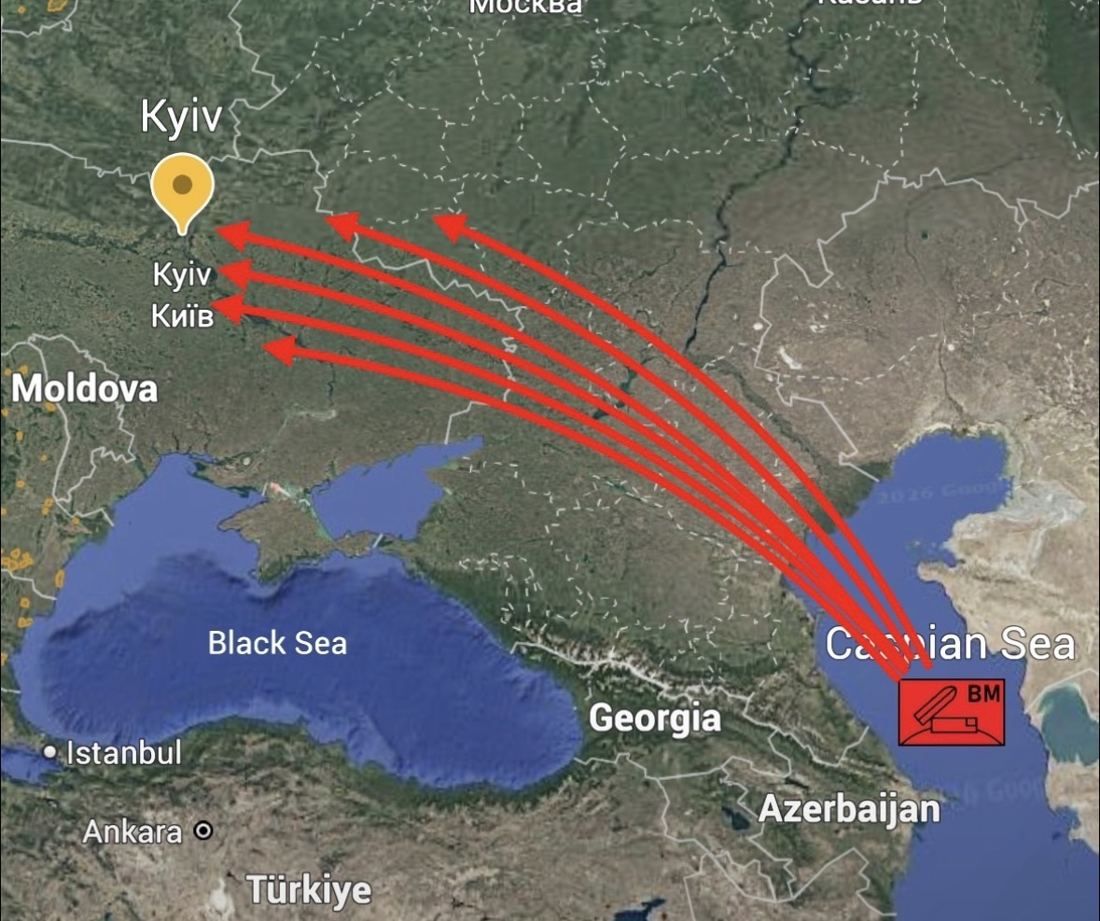
A At about 02:15 on the night of 16–17 September the alert was red and it said ballistic. Distance: 0 km. Негайно в укриття: immediately to shelter. Ціль над Київ. Рахунок на секунди: the target is over Kyiv, the count is in seconds. Do not approach windows. Two walls between you and the street.
A I heard the explosions from outside my hotel window on the way down. That sound will stay with me a long time.
B This was described to me as an unusually large attack, launched from aircraft and from ships as well as by drone, rather than the routine drone harassment.n8
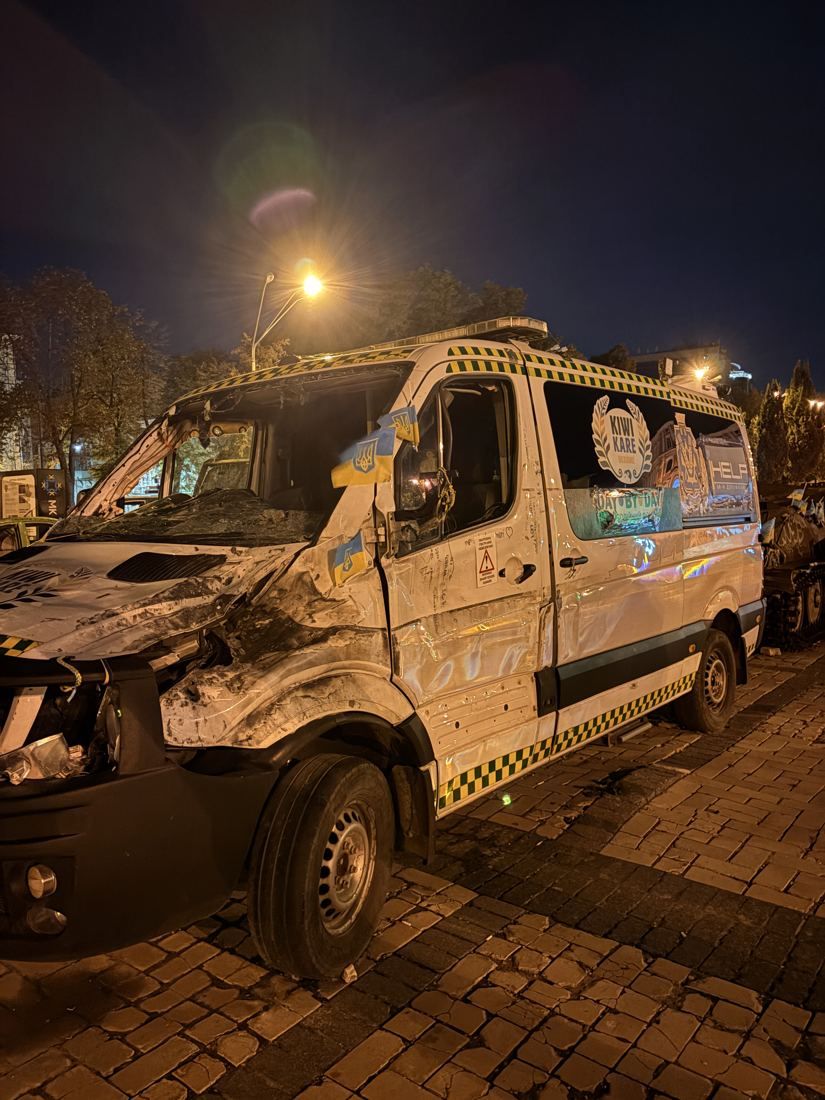
D I am including the alert screens and the night photograph as evidence that I was there, not as documentation of the attack itself. I cannot attribute a specific munition to a specific effect and I am not going to try. What I can testify to is the experience of being a civilian in a city under ballistic attack at two in the morning, and what it does to your sense of what "operating conditions" means.

“If the alarm sounds after the procedure has started, the procedure continues.”
Principle described to the author at the UTCC, Kyiv, 17 September 2026 B
B A surgeon from Zaporizhzhia had raised the question directly at a professional meeting in Istanbul: is it acceptable to transplant while the city is being bombed? The operating answer in Ukraine is that once the operation is underway it does not stop.
D This is easy to sensationalize and I would rather explain the clinical logic, because the logic is sound and the sensationalism obscures it. A transplant underway is a time-critical operation on an anticoagulated, immunosuppressed patient with a graft on a clock. Abandoning the field to go to a shelter is not a neutral act; it is a decision to harm the patient in front of you in exchange for a reduction in a probabilistic risk to the team. Ukrainian surgeons have concluded that the patient on the table is the immediate clinical responsibility and the external threat is a condition to be managed. That is not recklessness. It is a triage judgment made under constraints most of us will never face.
B They also told me that planned medical care does not stop, and that the system does not suspend scheduled treatment because of the war. They described military field hospitals as primary targets, with the consequence that civilian hospitals absorb functions that would otherwise sit with military medicine. I make no claim about targeting doctrine or the lawfulness of any attack; I am reporting what Ukrainian officials told me about how they plan around it.
Zaporizhzhia
B Zaporizhzhia has a transplant center doing kidneys and livers and a substantial number of donors. After a Ukrainian advance in the region, a procurement took place in an operating room from which the team could see the front line.
B In the east, around Kharkiv, three or four donors were managed with help from Karamian's own team, who traveled out to assist.
“Organ donation does not stop because there is a war.”
The point the Ukrainian team drew from the Zaporizhzhia case B
D I have carried a lot of coolers through a lot of hospital corridors. I have never done it within sight of an active front. The detail I keep returning to is not the bravery, which is obvious, but the ordinariness: the case was worked the way any case is worked, with the same checklist and the same clock, in a building where the windows faced the war.
Section 07
A system that grew during an invasion
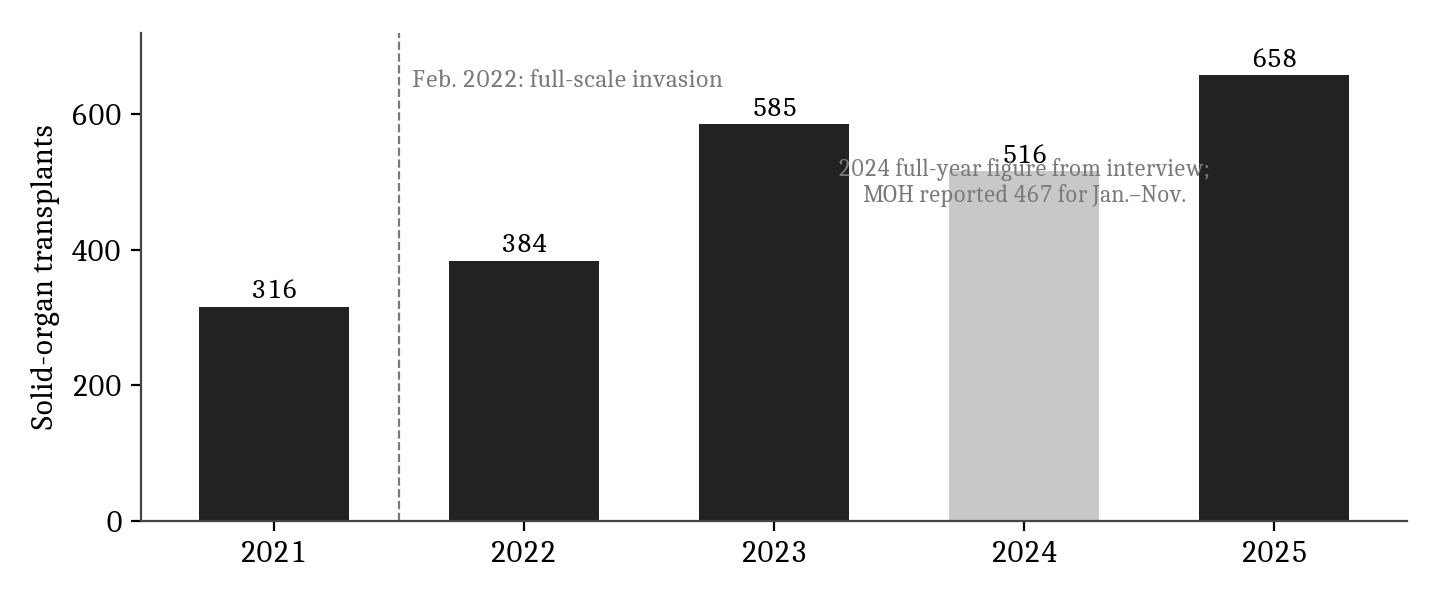
C Ukraine performed 316 solid-organ transplants in 2021, the last full year before the full-scale invasion. In 2022, the first year of that invasion, it performed 384, a 20% increase over the pre-war baseline, across 32 centers.13 In 2023 it performed 585, a figure the Ministry of Health has since published, confirming what I was told in interview.14 For 2024 I was given 516; the Ministry reported 467 for the first eleven months (311 kidneys, 93 livers, 63 hearts), with more than 65% from deceased donors, which is consistent with that full-year figure but does not confirm it.15n9 In 2025 Ukraine performed 658 organ transplants alongside 490 hematopoietic stem cell transplants.16
Figure 2. Ukrainian solid-organ transplants, 2021–2025
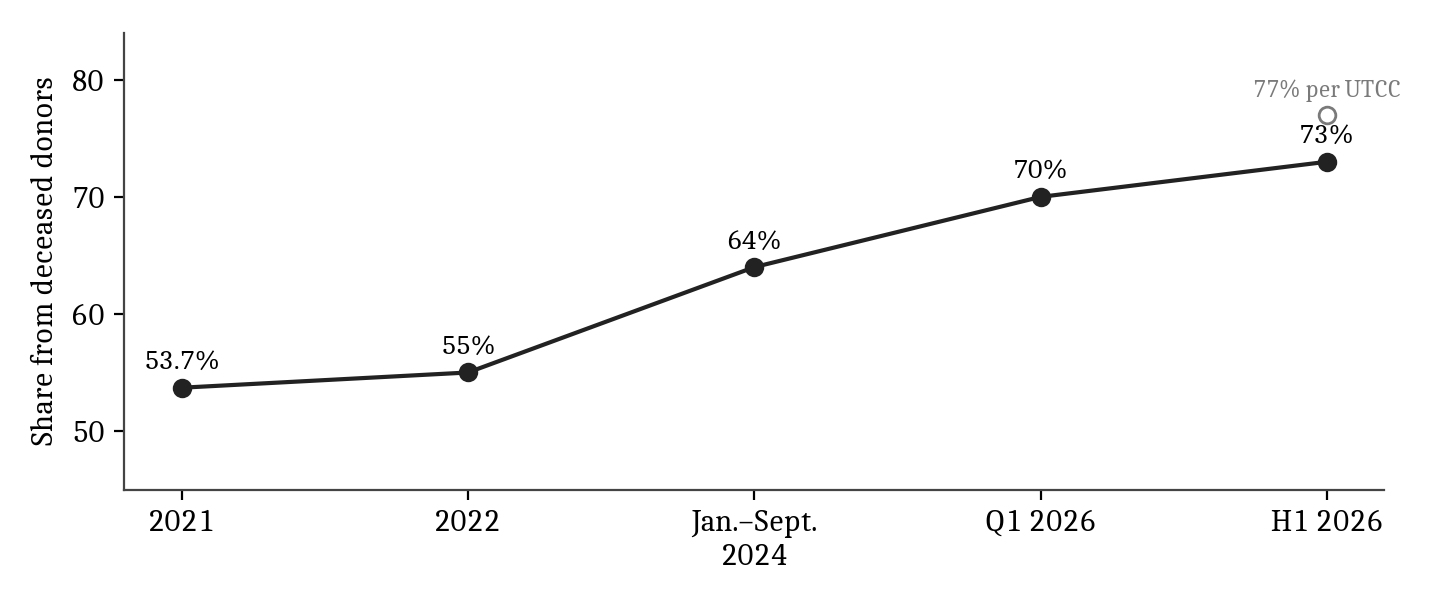
C The more consequential trend is compositional. The deceased-donor share of Ukrainian transplantation has moved from 53.7% in 2021 and 55% in 202213 to 64% in the first nine months of 2024,15 70% in the first quarter of 2026,17 and 73% in the first half of 2026 according to the Ministry of Health (the UTCC's own summary gives more than 77%).9
D That is the whole story compressed into one series. Ukraine is executing the transition from a living-donor-dependent program to a deceased-donor program. That transition is precisely the one that requires procurement infrastructure (referral, brain-death determination, family authorization, donor management, logistics) rather than surgical capacity. It explains, better than anything else I heard, why the UTCC is looking at the OPO model.
Figure 3. Ukraine's shift to deceased donation
Where the Ukrainian system is actually constrained
| First half of 2026 | Count | Note |
|---|---|---|
| Potential donors identified after brain-death determination | 94 | Across 21 reporting facilities |
| Effective donors (organ recovery proceeded) | 80 | 85% conversion from identified potential donors |
| Organs transplanted from those donors (author's calculation) | about 239 to 252 | 73% to 77% of 327 transplants; about 3.0 to 3.15 organs per donor |
C Three oblasts, Ternopil, Chernivtsi and Kirovohrad, recorded zero effective donors in the same period.9
D Conversion from identified donor to effective donor is 85%, and yield per donor is high. Neither looks like the limiting step. What the published data point to is how few potential donors are identified in the first place, and that three regions identified none at all. This is a strong signal rather than a completed bottleneck analysis, but it is the exact failure mode that referral requirements, death record review, and donor hospital development exist to address. Poland's 2021–2025 data (Section 4) suggest the same lever moves the same way.
Section 08
The logistics experiment
Every procurement professional reading this knows the clock. Ukraine runs that clock with closed airspace, unpredictable roads, degraded rail, an electrical grid under attack, and a shortage of the perfusion devices that would otherwise buy time.
B Organs mostly move by car. That creates ischemic-time problems, particularly for liver. Machine perfusion pumps are arriving for hearts and pilot work is underway.n10
B The more interesting piece is aviation. A civilian-run emergency helicopter capability was in development from 2021, paused at the invasion, and revived from 2023. The Ministry of Health renewed a collaboration between the UTCC, the national medical emergency service, and the State Emergency Service, which itself has the deepest working relationship with military evacuation. The arrangement was described to me as streamlined to the point that take-off does not require case-by-case permission.
B Eligibility started with hearts. Critical livers may soon qualify, and lungs where mechanical support is involved, effectively a status-1A-equivalent threshold. A flight can carry a maximum of two coordinators. After roughly ten transports the funding question arrived: officials asked why volume was so high, and sustainable financing is now the open issue.n11
B They are also considering drones. Ukraine is among the most advanced drone-operating countries in the world, and cooperation between a drone company and a helicopter service was described as a cost-saving avenue. Government approval, I was told, can come surprisingly quickly.
D No organ has been reported moved by drone and I am not claiming one has.n12 What I am claiming is narrower and, I think, more interesting: a country with severe constraints and a mature unmanned-aviation industrial base is treating organ transport as a solvable engineering problem rather than an accepted limit. American transplant logistics has had commercial aviation available for fifty years and has innovated in that lane considerably less.
A structural contrast B
Poland maintains direct communication with its military and relies on it to move organs, treating private aviation as prohibitively expensive. Ukraine, at war, relies less directly on its military (the military has a war to fight) and is building civilian and emergency-service capacity to fill the gap. The country not at war leans on its army; the country at war is building around it.
Section 09
Writing regulations while being shelled
The detail I find hardest to convey to American colleagues is this one.
B Ukraine has active projects with the European Commission and is working toward a set of requirements with a deadline in August 2027.
C That date is not arbitrary. EU Regulation 2024/1938 on substances of human origin, which replaces the old blood and tissues-and-cells directives, applies from August 2027.18 Organs are excluded from that regulation and remain governed by Directive 2010/53/EU, which requires each member state to designate a competent authority and to operate a quality and safety framework covering donor and organ characterization, full traceability, and serious adverse event reporting.19
C Ukraine's accession negotiations opened their first cluster, Fundamentals, on 15 June 2026, and External Relations on 14 July 2026.2021 Chapter 28, Consumer and Health Protection, sits in Cluster 2, Internal Market, which has not yet been opened. The European Commission's 2025 enlargement report rated Ukraine's progress on Chapter 28 as "good progress," noting new licensing arrangements for blood donation activity.22 The UTCC's own year-end statement says the Commission has confirmed full alignment of Ukraine's blood system with EU requirements.16n13
D Put the pieces together and a strategy is visible. Ukraine has cleared, or nearly cleared, the blood side of the SoHO regime. The organ side runs on a separate instrument that requires a designated national competent authority with traceability and adverse event reporting. The UTCC is positioning itself to be that authority. And the operational substrate it needs, consistent donor characterization and reporting across every oblast, including the three that produced no donors at all, is the same substrate it needs to raise its donation rate.
D The EU accession requirement and the donation-rate problem have the same solution. That is the most useful strategic observation I brought home, and it was not obvious to me before I went.
B The General Director was also candid about frustration with European partners: bureaucratic delay, and a reluctance in some quarters to use the word war. Ukrainians, he said, are direct. Blood and organ sharing with the EU remain works in progress.

Section 10
Three architectures
Strip the three systems to their organizational skeletons and the difference is immediate. The United States distributes across four kinds of institution what Poland and Ukraine hold in one. That is not a detail of implementation. It is the design.
| United States | Poland | Ukraine | |
|---|---|---|---|
| Donor hospital | Mandatory referral of every death and imminent death | In-house transplant coordinator | Transplant coordinator; uneven coverage |
| Procurement | One of 55 OPOs, each with an exclusive service area: evaluation, authorization, recovery | Poltransplant: national coordination, waiting list and allocation, registries, coordinator training, living-donor coordination, international exchange | UTCC and ЄДІСТ: national coordination and allocation, nine state registers, blood and transfusion service, bone-marrow registry, transport authorization |
| Allocation | OPTN, a separate national contractor | Inside Poltransplant | Inside UTCC |
| Oversight | CMS certifies OPOs; HRSA oversees OPTN. Four institutions, four regulators | Ministry of Health; FOEDUS-EOEO for cross-border exchange. One agency | Ministry of Health; EU Directive 2010/53/EU alignment. One agency, widest remit |
| Consent | Affirmative authorization | Presumed consent with a register of objections | Explicit opt-in; family consulted where no declaration exists |
D The American debate about OPO consolidation is, viewed from Warsaw or Kyiv, a debate about whether to move toward an architecture those countries already have. Note the direction of travel in the other lane: the UTCC told me it is interested in moving toward the American regional model. Both systems are looking across at the other.
Section 11
Scale-adjusted comparison
Comparing Poland or Ukraine with the whole United States is close to meaningless. The United States has roughly 342 million people; Poland about 37.4 million (the population implied by Poltransplant's own per-million rate); Ukraine about 28.5 million in government-controlled territory, according to the Institute for Demography's October 2026 estimate.23 (The September draft used about 32 million; the lower figure raises Ukraine's per-capita rates.) Every figure below is normalized, and the Ukrainian denominator remains approximate.
A more useful frame for an American reader: Florida has about 23.4 million people and is served by three OPOs after the Miami decertification, plus an out-of-state operator now holding the Southern Florida service area. Poland, at 1.6 times Florida's population, is served by one national agency. Ukraine, at roughly 1.2 times Florida's population, is served by one.
Figure 4. Per-million comparison
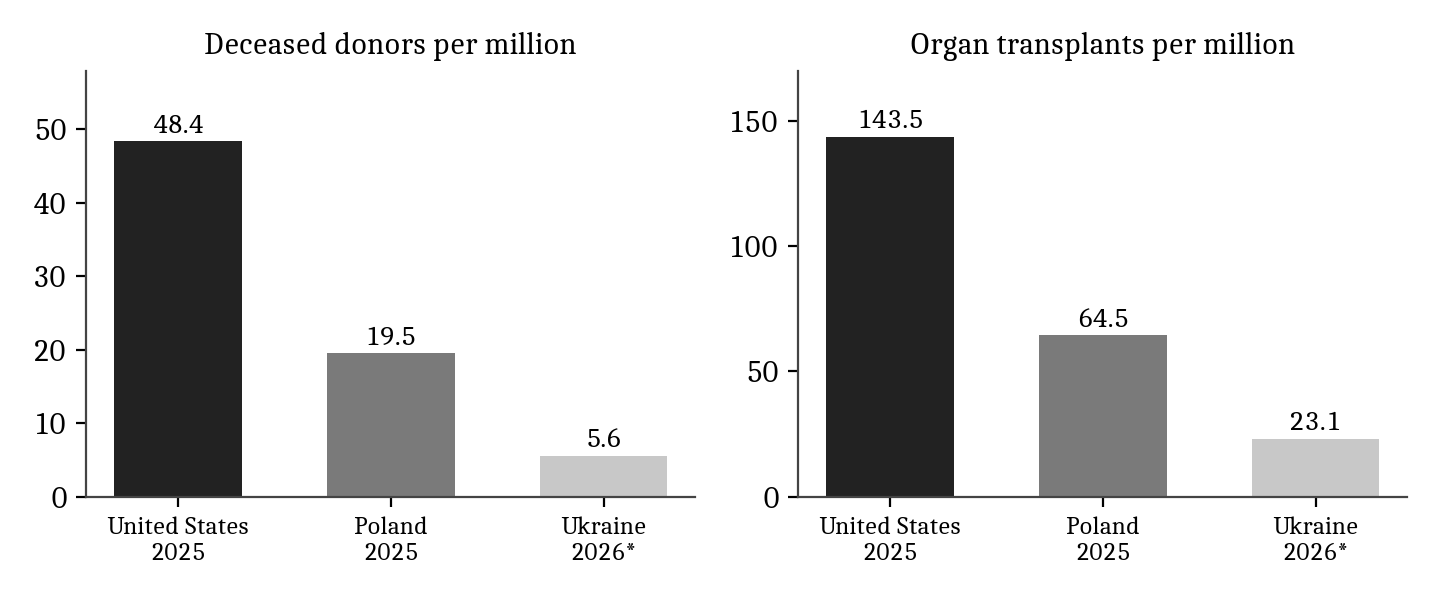
D The United States is not slightly ahead on deceased donation. It is roughly two and a half times Poland and about nine times Ukraine per capita. Any American discussion of international lessons has to start by acknowledging that. Whatever is wrong with the OPO system, it is currently producing the highest deceased-donation rate of the three countries studied here by a very large margin.
C One correction to the framing an American reader may expect: the United States is not the world leader. Spain reported 51.9 deceased donors per million in 2025 against the American 48.4, and has led internationally for more than three decades on the strength of hospital-based intensivist coordinators and a national agency rather than its opt-out law.24
D That matters in two ways. It means the American system is very good but not the ceiling, so "learn from abroad" is not a rhetorical courtesy. And it means the structural template Ukraine should probably be studying is Spain's, a single national agency with hospital-based coordinators, which is architecturally far closer to what the UTCC already has than 55 competing regional nonprofits. The UTCC has had a working relationship with the Spanish DTI Foundation since a 2021 delegation visit led by its General Director.
And then there is the other ratio.
Figure 5. Organs transplanted per deceased donor
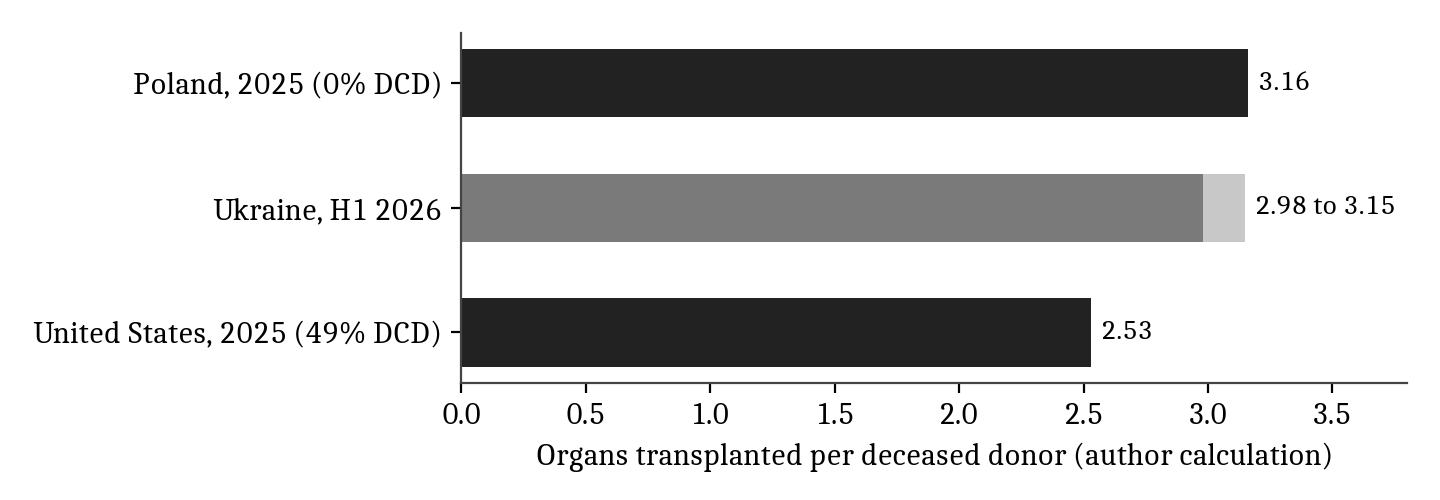
D I think the explanation is mostly DCD, and I think it matters more than it first appears. A DCD donor yields fewer transplantable organs than a brain-dead donor. Poland and Ukraine, both brain-death-based, land at about three organs or more per donor. The United States, at 49% DCD, has expanded the donor pool enormously and in doing so has diluted average yield per donor. Both of those are consequences of the same decision, and neither is a failure.
Now look back at the two CMS outcome measures. One counts donors. The other counts organs transplanted. They share a denominator, but a strategy that maximizes the first, aggressive DCD expansion into marginal donors, mechanically depresses yield per donor and can hold back the second. An OPO can improve on one measure and lose ground on the other while doing exactly what the policy asked.
D I am not claiming this dynamic explains any particular OPO's tier placement, and I have not done the analysis that would be needed to show it. Establishing it would require donor-level analysis controlling for donor age, cause of death, medical complexity, authorization, and organ discard; and "effective donor" in Ukrainian reporting may not be defined identically to "utilized donor" in OPTN data.n17n19 I am claiming that the international comparison makes the tension visible in a way domestic data alone do not, and that it is a question CMS should be able to answer before January 2027.
| OPO | Region | Tier (CY2021) | Status |
|---|---|---|---|
| Florida OPO A | Central | Tier 1 | Automatic recertification |
| Florida OPO B | West central | Tier 2 | Certified; service area open to competition |
| Florida OPO C | North | Tier 3 | Decertification-eligible |
| Florida OPO D | South | Tier 3 | Decertified Sept. 2025; service area reassigned to an out-of-state OPO, Jan. 2026 |
C Tier assignments as published in the 2023 interim aggregated performance report, assessing CY2021.2 Organizations are de-identified by the author's choice; the assignments themselves are public.n16
A D I have worked at three of those four organizations, spanning all three tiers. What I can say from inside is that the differences were real and were not differences of effort. They were differences in hospital mix, in donor demographics, in staffing depth, and above all in the accumulated quality of relationships with intensive care units, relationships that take years to build and that do not transfer with a service area when it changes hands.
D That last clause is the part I would most like a policymaker to sit with. When a DSA is reassigned, the contract moves. The institutional memory of which neurosurgeon at which community hospital will call you at 3 a.m. does not.
Section 12
What is actually transferable
D Everything in this section is my interpretation. None of it is a finding.
To the United States, from Poland. Poland runs national coordination, a national list, registries, coordinator training, and international exchange out of one agency with a public-facing brand. Poles know what Poltransplant is. Almost no American knows what an OPO is, or that one exists in their region, until someone in their family dies. The transferable piece is not consolidation; that is a much larger argument than this paper can carry. It is the observation that national visibility is a procurement asset, and that a fragmented regional structure makes it structurally difficult to build. Poland and Ukraine both run public education as a core national function. In the American system it is 55 separate efforts.
To the United States, from Ukraine. Ukraine's digital consent infrastructure is, in one specific respect, ahead of ours. ЄДІСТ is a single national system of nine registers with consent filing through the national e-government app. The United States has no unified national donor registry; we have fifty-plus state registries that do not natively interoperate. A Ukrainian coordinator queries one system. An American coordinator's answer depends on which state the patient last held a license in. And the logistics posture is worth studying honestly: a country with closed airspace, a damaged grid, and degraded rail treats organ transport as an engineering problem with an active solution pipeline.
To Poland and Ukraine, from the United States. If the UTCC does pursue elements of the American model, the part worth taking is not the ownership structure. Fifty-five competing regional nonprofits under federal certification pressure is not something I would recommend to anyone building from a centralized base. The part worth taking is the operational discipline that American procurement built to solve exactly Ukraine's problem, donor identification in hospitals with no transplant program and no institutional stake:
- A mandatory referral requirement. Every death and imminent death, reported. This single regulatory mechanism is the main reason American donor identification does not collapse in rural and community hospitals. Ukraine's three zero-donor oblasts are a referral problem before they are a training problem.
- Systematic death record review. Retrospective audit of every hospital death to find missed donors. Cheap, unglamorous, and the highest-yield quality tool we have.
- Donor hospital development as a standing function. Staff whose entire job is the relationship with non-transplant hospitals.
- A credentialed non-physician coordinator workforce. Spain and Poland use physician and nurse coordinators. Ukraine cannot spare intensivists. A professionalized, board-credentialed, non-physician coordinator corps is the more scalable answer for a country short of doctors, and it is the piece I am personally best placed to speak to.
- Standardized family approach and decoupling. Especially load-bearing in Ukraine, which runs explicit opt-in consent where the family conversation carries more weight than it does under Polish presumed consent.
D Keep the centralized skeleton. Import the playbook. Skip the ownership structure.
The consent question, briefly. C The three countries occupy three positions: American affirmative authorization, Polish presumed consent with a central register of objections, and Ukrainian explicit opt-in, where a lifetime declaration filed in ЄДІСТ or through Diia governs, family are consulted where no declaration exists, and donation cannot proceed where there is no one to ask.12 D Note the ordering. The country with the most permissive consent regime, Poland, has a deceased-donor rate well under half that of the United States. The international literature has said for years that consent model is not the main driver of donation rates and that organizational infrastructure is. These three countries are a small but clean demonstration of it, and the observation cuts against the most common American reform proposal, which is to switch to presumed consent.
Section 13
The CMS question
I said at the outset that I am not neutral. Here is the argument, with the counter-argument given its due, because a policy position that cannot survive contact with the case against it is not worth publishing.
What the rule is trying to fix. C The case for the Final Rule is strong and should not be caricatured. OPO performance was previously self-reported against measures the OPOs themselves influenced. Variation between service areas was enormous and largely unexplained by donor demographics. CMS projected that bringing every OPO to the top-quartile benchmark could yield roughly 5,600 additional organs a year.1 Patients on a waiting list do not care about institutional continuity. And the July 2025 HRSA findings describe failures that no amount of professional loyalty should excuse.4
What concerns me. D Four things, in descending order of confidence.
- The measures may conflict. Figure 5 is the international version of this argument, and it is a hypothesis generated by an international comparison, not a finding. Whether DCD expansion raises donors while lowering organs per donor at OPO level is an empirical question CMS is far better placed to answer than I am, and I would want it answered before decertifications proceed.
- The benchmark is relative, not absolute. The pass mark is the lowest rate among the top quartile.1 Half the field is below median by construction, every year, no matter how much the whole field improves. A system-wide gain does not reduce the number of organizations in jeopardy.
- What transfers with a service area is the contract, not the capability. Procurement runs on relationships with specific intensivists at specific hospitals, built over years. I have watched those relationships determine whether a referral comes in at all. Nothing in the recertification framework accounts for their destruction and rebuilding, and the 2026 proposed rule's shift toward continuous DSA-level competition increases the frequency with which it could happen.2
- The pace. Roughly 42% of OPOs were on track for automatic decertification under CY2021 data, and proceedings begin January 2027.2 I do not know of a modeled estimate of what happens to national donation volume during a transition of that magnitude, and I would want one.n18
What I am not arguing. D I am not arguing that the rule has already damaged the system; the measured evidence for that does not exist yet and I will not pretend otherwise. I am not arguing against accountability, against decertifying an OPO that has genuinely failed, or against the HRSA safety reforms. The 2025 Florida decertification followed documented findings that would have justified it under any framework.3
I am arguing for one thing: that comparative evidence should inform structural change before the change is irreversible. Poland rebuilt from a system its own national auditor called a crisis to a record year, and its own data show the growth came from identifying more donors.56 Ukraine doubled volume during an invasion. Neither is a template for the United States. Both are natural experiments in what actually moves donation rates, and we have not looked at either.
“Before we fix the American organ procurement system, have we adequately studied how comparable systems work, and what happens when institutional infrastructure is fundamentally altered?”
Section 14
Limitations
- Selection. I spoke with national coordination leadership, not with frontline coordinators at donor hospitals, and not with any family. Leadership describes systems as designed. Floors run differently.
- The Ukrainian hospital visit did not happen. Everything I report about Ukrainian clinical operations is interview-derived, not observed.
- The follow-up interviews have not happened. Volume 1 is built on single interviews in each country, corroborated against published data where possible.
- Language. Both meetings ran in English, a second language for my hosts. Nuance was lost in both directions.
- Denominators. The Ukrainian population figure is genuinely uncertain. Definitions of "potential donor," "effective donor," and "utilized donor" may not be equivalent across registries; this is the largest threat to the validity of Figure 5.
- Author position. I work in the system I am comparing and hold a policy position on its restructuring. I have tried to label interpretation as interpretation throughout; readers should discount accordingly.
- Unverified wartime claims. I have not independently documented the attack profile described to me or its effect on UTCC's systems. Both are attributed and noted.
Section 15
Questions for Volume 2
These are the questions the follow-up interviews are meant to close. Some have been partly answered from published data since the September draft; those are marked.
Ukraine
- Is Ukraine formally considering regional, OPO-style procurement organizations, or importing OPO functions into the existing national structure?
- Which specific aspects of the American model were studied: referral requirements, death record review, donor hospital development, coordinator credentialing, allocation?
- What did the 2023 Mayo Clinic and University of Florida visit produce in writing?
- How many transplant coordinators does Ukraine employ, and what is their training and credentialing pathway? (The single largest gap in this report.)
- What is the division of responsibility between the UTCC and transplant hospitals for donor identification?
- What are UTCC's redundancy and backup procedures for its information systems under attack?
- How are hearts, lungs, livers and kidneys currently transported, by modality and share?
- What formal agreements exist with the State Emergency Service, and what is the funding mechanism?
- Have civilian aviation companies been formally contracted? Has an organ ever been moved by drone, and is there a formal pilot program?
- What constitutes uncontrolled DCD in current Ukrainian practice, how many cases have occurred, and what ethical objections remain?
- What is the current national referral requirement, if any, for non-transplant hospitals?
- What international organ-sharing agreements are in development, and on what timetable for Directive 2010/53/EU alignment?
- What accounts for the three zero-donor oblasts, and what is the plan for them?
- Which figure for the deceased-donor share in the first half of 2026 is correct, 73% or 77%, and what was the full-year 2024 total?
Poland
- What drove the rise in reported potential donors from 546 in 2021 to 969 in 2025? (Partly answered: the growth was in identification, not conversion. The cause is still open.)
- How are hospital coordinators employed and financed: by the hospital, by Poltransplant, or jointly?
- Exact current coordinator counts and hospital coverage, to replace the field estimates in Section 4.
- Is there an active policy discussion about introducing DCD, and what would have to change ethically or legally?
- What is the living-donor strategy, given that 106 living-donor transplants in 2025 is regarded internally as low?
- What incentives, if any, exist for donor hospitals?
- Volume and direction of FOEDUS exchange for Poland specifically.
- Current national donor exclusion criteria, if published.
Section 16
Conclusion
I did not go to Poland and Ukraine to find a system that should replace ours. I went because the United States is about to restructure its procurement architecture and the conversation about it has been conducted entirely in English, entirely domestically, and entirely without reference to the fact that other countries solve the same problem differently and sometimes better.
What I found is that the three systems distribute identical functions across very different institutions and land at very different operating points, and that each has something the other two do not. Poland has national coherence, a public identity, a record donation year built on identifying more donors, and no DCD program at all. Ukraine has a single digital consent system, extraordinary logistical improvisation, and a transplant volume that doubled during an invasion, constrained severely by donor identification. The United States has the highest deceased-donation rate of the three, the deepest DCD infrastructure, and the most professionalized coordinator workforce, inside the most fragmented structure, now under the most pressure.
The lesson is not that Poland is better, or Ukraine, or the United States. The lesson is that the functions are separable from the institutions that currently perform them, and that we should know which functions are load-bearing before we change who owns them.
At about two in the morning on 17 September I ran down a stairwell in central Kyiv while ballistic missiles came in over the city, and the next morning I sat across a table from two men whose systems had been knocked offline that night, who had come to work anyway, and who spent two hours asking me careful questions about how American organ procurement organizations identify donors in hospitals that do not have transplant programs.
The architectures are different. What happens inside them is not.
A Leaving the country, at the border, I was told: "Sir, goodbye. Thank you. Thank you for your service." I have thought about that a great deal since. I do not know whether it was thanks for studying there, for the medical work, or simply for showing up. Probably some of each. My note that morning, written in the car, reads: nicest scary people ever.
Acknowledgments
My thanks to Dmytro Koval and Artur Karamian at the Ukrainian Transplant Coordination Center, who made time on a morning when their systems were down and their staff were recovering from an attack, and whose candor made this report possible. To Olesia Tsykaliuk of the UTCC's Department for the Management and Monitoring of State and International Programs, who arranged the visit. To Dr. Anna Pszenny of Poltransplant and Dr. Łukasz Górski of the Central Clinical Hospital in Warsaw, whose welcome was among the warmest professional courtesies I have received, and to Jarosław Czerwiński, who arranged the invitation. And to my then-employer and its parent hospital system, whose institutional letter of verification made the Ukrainian visit possible.
I intend to return to Europe to continue this work, and I am grateful to everyone in three countries who treats organ donation as a shared professional undertaking rather than a national one.
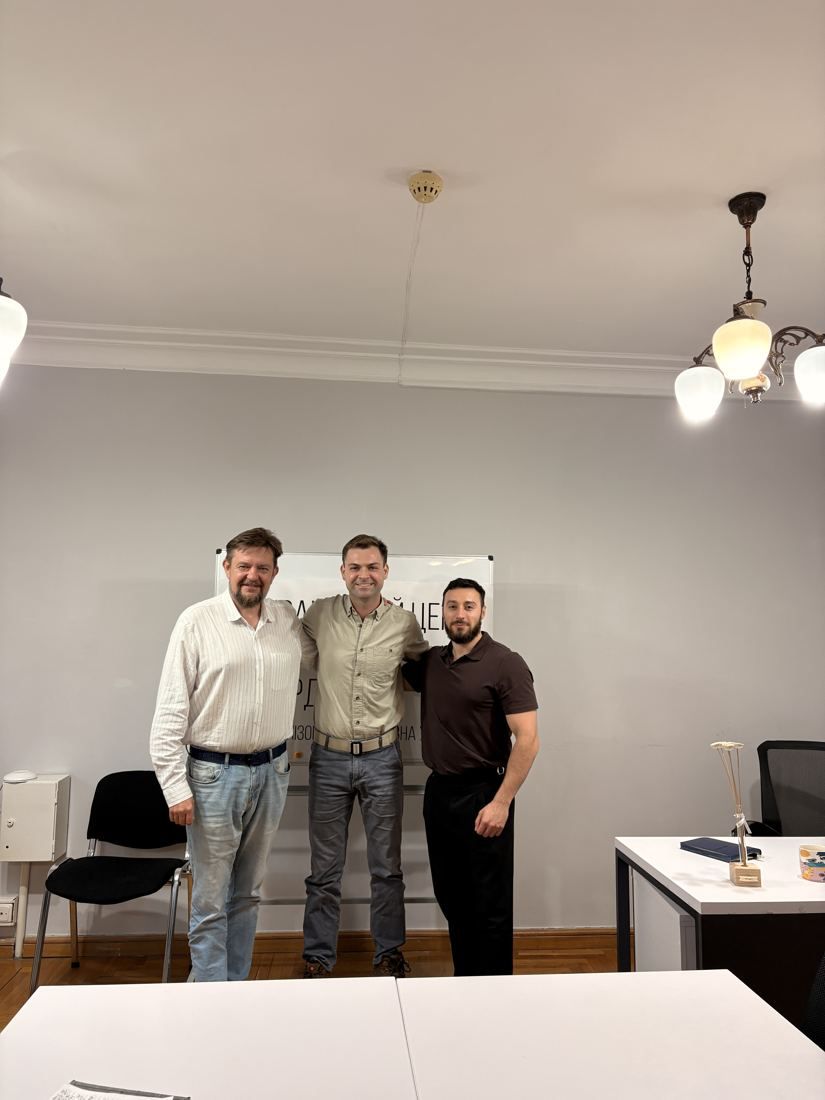
Conflicts and disclosures. The author works in United States organ procurement and holds the policy position on CMS regulation stated in Sections 3 and 13. Travel was self-funded. No institution reviewed or approved this report. The views are the author's alone and do not represent any employer, any hospital system, Poltransplant, or the UTCC. Individual organ procurement organizations are referred to generically throughout; this is an editorial choice, not a limitation of the underlying public data. Photographs. All photographs by the author, September 2026, reproduced with the consent of those pictured. No patient, donor, or clinical setting is depicted.
Notes on open items (Volume 2)
n1. Warsaw clinical visit. A visit with a senior professor at a Warsaw transplant center was cancelled when I left for Ukraine a day early. Volume 2 will include a clinical perspective if a visit or call can be arranged.
n2. Polish coordinator network. Field estimates to be replaced with Poltransplant's own counts in Volume 2.
n3. Polish donor exclusion criteria. Current national criteria to be confirmed with Poltransplant.
n4. U.S. donor cause-of-death distribution. A current national breakdown from OPTN/SRTR data will be added in Volume 2.
n5. Comparative listing rates. Waiting-list listing rates relative to the dialysis population, for the U.S. and Poland, will be added in Volume 2.
n6. Poland's turnaround. Section 4 shows where the growth came from (identification). Why it came is the lead question for the Poltransplant follow-up.
n7. UTCC systems. The effect of the attack on UTCC's information systems was described to me and is not independently documented. Details are deliberately general.
n8. Attack profile, 16–17 September 2026. Ukrainska Pravda reported that on the night of 16–17 September Russia attacked Ukraine with drones and with anti-ship, ballistic and cruise missiles, and that Kyiv came under ballistic attack again on the evening of 18 September. The specific launch platforms described to me are not independently documented.
n9. Ukrainian 2024 total. The interview figure (516) is consistent with, but not confirmed by, the Ministry's January–November figure (467).
n10. Machine perfusion in Ukraine. Device counts and the status of pilot work to be confirmed with the UTCC.
n11. Emergency aviation. Agreements with the State Emergency Service and the funding mechanism to be confirmed.
n12. Drone transport. No organ is known to have been moved by drone; whether a formal pilot exists is a Volume 2 question.
n13. EU blood-system alignment. The UTCC's year-end claim of full alignment is reported as the UTCC's statement; Commission documentation to be located.
n14. Ukrainian DCD. Not separately reported in public statistics; isolated uncontrolled cases were described to me in interview only.
n15. Ukrainian donor cause of death. A current national distribution to be requested from the UTCC.
n16. CMS tier data. Tiers shown are from the CY2021 assessment. The final report on CY2024 data, used for the 2026 certification cycle, will be reviewed in Volume 2.
n17. OPO-level analysis. The correlation between an OPO's DCD share and its two CMS measures has not been analyzed here and is proposed for Volume 2.
n18. Transition impact. I am not aware of published modeling of national donation volume during a large-scale OPO transition; any such work will be reviewed in Volume 2.
n19. Definitions. "Effective donor" (Ukraine), "actual donor" (Poland) and "utilized donor" (OPTN) may not be equivalent; definitions to be confirmed.
n20. 2023 U.S. visit. Specifics of the Ukrainian delegation's 2023 visits to Mayo Clinic and the University of Florida to be confirmed with the UTCC.
References
1. Centers for Medicare & Medicaid Services. Organ Procurement Organization (OPO) Conditions for Coverage Final Rule: Revisions to Outcome Measures for OPOs. Fact sheet, 20 November 2020. cms.gov
2. Holland & Knight. CMS Issues Additional Guidance on the Organ Donation Process. March 2026; and OPO tier data from the 2023 OPO Interim Annual Public Aggregated Performance Report (CY2021 assessment). cms.gov
3. U.S. Department of Health and Human Services. Press release announcing the decertification of a Florida organ procurement organization, 18 September 2025. hhs.gov
4. Health Resources and Services Administration. Reforms to organ procurement oversight for donation after circulatory death, July 2025; and HRSA directive for OPTN DCD policy development. hrsa.gov
5. Poltransplant (Centrum Organizacyjno-Koordynacyjne do Spraw Transplantacji). Pobieranie i przeszczepianie narządów w Polsce w 2025 r. (Procurement and transplantation of organs in Poland in 2025); and Biuletyn Informacyjny 2025. files.poltransplant.org.pl
6. Najwyższa Izba Kontroli (Supreme Audit Office of Poland). Report on the national transplantation program. nik.gov.pl
7. Donation after circulatory death among U.S. deceased donors, 2000–2025 (OPTN data). JAMA, February 2026; summarized by HealthDay, February 2026.
8. United Network for Organ Sharing. U.S. surpasses 49,000 organ transplants while deceased organ donations dip. January 2026. unos.org
9. Ministry of Health of Ukraine. First-half 2026 transplantation results (327 organ transplants; 94 potential and 80 effective donors), July 2026; and UTCC first-half 2026 summary. moz.gov.ua; utcc.gov.ua
10. Importance and Potential of European Cross-Border Deceased Donor Organ Allocation Through the FOEDUS-EOEO Platform. Transplant International, 2023.
11. Ministry of Health of Ukraine. Unified State Transplantation Information System (ЄДІСТ). moz.gov.ua
12. Law of Ukraine No. 2427-VIII of 17 May 2018, "On the Application of Transplantation of Anatomical Materials to a Person." zakon.rada.gov.ua
13. Ministry of Health of Ukraine. In 2022, Ukrainian doctors performed 20% more organ transplants than in pre-war 2021. moz.gov.ua
14. Ministry of Health of Ukraine. In 2023, 585 organ transplants were performed in Ukraine. moz.gov.ua
15. Ministry of Health of Ukraine. 373 organ transplants performed in the first nine months of 2024; and January–November 2024 results (467 transplants). moz.gov.ua
16. Ukrainian Transplant Coordination Center / Cabinet of Ministers of Ukraine. 2025 year-end transplantation summary. utcc.gov.ua; kmu.gov.ua
17. Ministry of Health of Ukraine. 159 transplants performed since the beginning of 2026: first-quarter results. moz.gov.ua; kmu.gov.ua
18. Regulation (EU) 2024/1938 on standards of quality and safety for substances of human origin intended for human application. eur-lex.europa.eu
19. Directive 2010/53/EU on standards of quality and safety of human organs intended for transplantation. eur-lex.europa.eu
20. Council of the European Union. EU and Ukraine open first accession negotiations cluster. 15 June 2026. consilium.europa.eu
21. Council of the European Union. Enlargement: EU opens accession negotiations with Ukraine on external relations policies. 14 July 2026. consilium.europa.eu
22. European Commission. Ukraine Report 2025, Enlargement Package; Chapter 28, Consumer and Health Protection. enlargement.ec.europa.eu
23. Institute for Demography and Social Studies, National Academy of Sciences of Ukraine. Population estimate for government-controlled territory, mid-2026 (28.5 million), as reported 22 October 2026.
24. Ministerio de Sanidad / Organización Nacional de Trasplantes (Spain). 2025 activity: 2,547 deceased donors (51.9 per million) and 6,335 transplants. sanidad.gob.es; ont.es